Commentary: In 2001, a Chicago ad agency foresaw the livestreamed execution
Published in Op Eds
On the morning of June 11, 2001, readers of the Terre Haute Tribune-Star turned to an inside page of the main section and saw a family in front of a television. In the full-page ad, the father shakes his fist at the TV while the mother and children lean in as the set casts its light across the darkened den like a projector in a picture palace. A box in the ad announced: “Closed Circuit Event. The Execution of Timothy McVeigh. Monday, June 11th. 7 a.m.”
At the federal prison in the Indiana city that morning, McVeigh died at 7:14 a.m., his execution televised to a closed-circuit audience of survivors and family members of those he killed in a 1995 terrorist bombing in Oklahoma City.
The ad came from Chicago. The Ungar Group agency placed it for “Citizens for Capital Punishment.” The New York Times, The Wall Street Journal and USA Today declined to publish it.
The ad grasped what the government had not: Put an execution on a screen, and it becomes a show, and the true subject of any show is its audience.
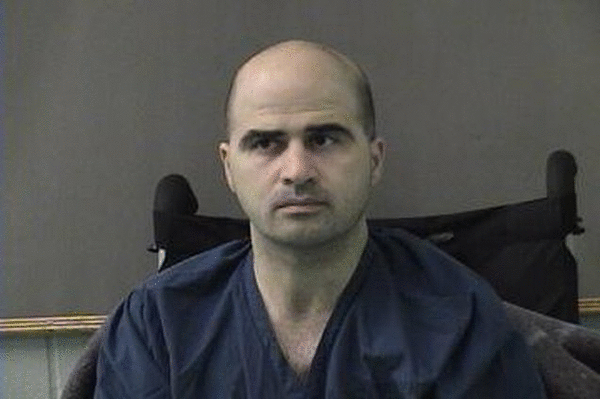
This year, Nidal Hasan, who killed 13 people at Fort Hood in 2009, is scheduled to face an Army firing squad at 1 p.m. Dec. 3, on the weekday and hour of his crime. The Pentagon announced it would be livestreamed, but on Thursday, President Donald Trump called it off.
In response to McVeigh’s crimes, Attorney General John Ashcroft authorized the first televised federal execution for survivors and victims’ families. In Oklahoma City, where McVeigh’s bomb killed 168 people, 232 survivors and relatives watched a closed-circuit feed as he lay with eyes on the camera overhead. McVeigh proposed a “public broadcast” and was refused. The line was humane and clear: The bereaved may watch, but the nation would not.
Defense Secretary Pete Hegseth proposed to erase that line this year. For now, it holds.
I offered to write music for McVeigh. When the prison barred me from federal property, McVeigh took up my case. In a letter that April, he proposed a call to the priest at St. Margaret Mary Catholic Church near the prison. If cameras carried the music by morning, he would catch it: “I’ll have a TV,” he said.
That May, a junior high class in East Los Angeles wrote to me, deciding I was mean based on my photo. One student begrudged McVeigh his music, though she added: “If I die I would like other people to play music for me.” On the eve of the execution, I conducted a brass prequiem — a requiem before the death — in that church, and McVeigh listened by telephone.
A prequiem, like any requiem, is addressed to the dying and to God. A livestream is addressed to everyone else.
The parish priest, the Rev. Ron Ashmore, also was the prison’s acting chaplain. The last time he and McVeigh spoke, Ashmore told me, McVeigh acknowledged the tragedy of the dead, “especially the children,” and the pain of their families, though he still saw himself a soldier at war with his government. His notorious “collateral damage” was, I always thought, a borrowing: The Pentagon’s own euphemism handed back to it.
The state and its enemy already shared a vocabulary. They need not now share a screen. Cate McCauley, a witness McVeigh chose, put it plainly: “Death is final. We shouldn’t glorify it, no matter who is doing the killing.”
Pope Leo XIV, Chicago’s native son, has called capital punishment “inadmissible.” In 1999, the Tribune published the series “The Failure of the Death Penalty in Illinois,” which helped persuade Gov. George Ryan, a Republican, to halt executions and later commute 167 death sentences. In 2011, Illinois abolished capital punishment, a verdict reached through documents, transcripts and exonerations, without anyone needing to watch.
Consider this spectacle: In 1936, as many as 20,000 people filled a lot in Owensboro, Kentucky, to see Rainey Bethea, a 22-year-old Black man, hang. Editorials called it a carnival; within two years, Kentucky moved its gallows behind prison walls.
The advertisement in the Tribune-Star showed no gurney, no prisoner, no warden. It showed Americans — mouths open while lit by the screen.
Three national papers declined to run that ad. For one week before Trump called off the plan, the Pentagon proposed to make it come true, with each of us cast as the family on the sofa.
_____
David Woodard is a conductor and writer based in Tampere, Finland.
_____
©2026 Chicago Tribune. Visit at chicagotribune.com. Distributed by Tribune Content Agency, LLC.


Comments