Commentary: Make America free again
Published in Op Eds
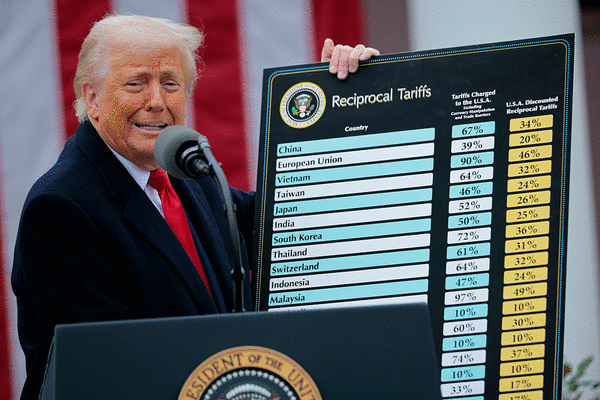
As we close in on the halfway point of President Donald Trump’s second term in office, it is a good time to take stock of how the American system of free enterprise is holding up.
The Economic Freedom of the World (EFW) index was just released by the Fraser Institute. It uses 46 indicators grouped into five areas to assess the degree to which countries permit their citizens to make their own economic choices.
Countries that keep taxes and spending low, protect private property under the rule of law, provide for low and stable inflation, allow free international trade, and limit burdensome government regulations score better on the index.
Now in its third decade, the index has been used in over 1,000 peer-reviewed studies to assess the effects of economic freedom on well-being. The evidence is overwhelming that economically free people are prosperous people. Those who live in more economically free societies enjoy higher incomes and less poverty. They work fewer hours and are more satisfied with their lives. They even live longer, are less likely to die in infancy, and seem to be better stewards of the natural environment.
In 2024, the latest year with complete data for all countries, Hong Kong retained its top rating of 8.53 out of 10. While still in first place, Hong Kong’s rating has fallen dramatically over the last few years from its high point of 9.21 in 2009. Venezuela scored last with a rating of 2.94. The United States received a rating of 8.21 in the final year of President Biden’s term, which was good enough for 5th place out of the 165 countries scored.
While more current data are not yet available for most countries, we were able to compile enough more recent data to project a score for the U.S. in 2025, the first year of Trump’s second term. Our preliminary estimate is U.S. economic freedom declined to 8.09 in 2025. Assuming no other countries changed, this means the U.S. ranking will fall to 7th overall.
Three of the five major areas of the EFW index were responsible for the decline.
First, the size of the U.S. government increased in 2025 thanks to increasing transfers and subsidies and the government’s socialist-like acquisition of equity stakes in more than two dozen firms.
Second, significant declines in judicial independence and even-handed contract enforcement resulted in the largest recorded single year drop in the property rights area.
Third, tariffs—the signature economic policy of the Second Trump Administration—have significantly limited the economic freedom of Americans. The president imposed a five-fold increase in the average tariff rate in his first year, raising it to a whopping 16.8 percent in 2025.
Only a handful of low-income countries, such as Sudan, Djibouti, and Iran impose higher tariffs. As a result, the country’s tariff ranking is projected to fall from 60th to 124th, and the broader area of trade freedom to fall 0.35 points in one year. This is the largest single year decline in U.S. trade freedom on record and pushes the country’s score in this area to the lowest recorded level going back to 1970.
The only good news is that the Federal Reserve, despite unrelenting pressure from the president, has continued to show improved monetary restraint resulting in lower and more stable inflation in 2025 compared with 2024. This is the one area of the index that shows a clear positive trend in 2025. It is also the area over which the president has been able to exercise the least control. Finally, despite claims to the contrary, we project little change in the regulatory environment in the U.S. in 2025.
Trump’s second term was supposed to portend the dawn of a new era. The preliminary data suggests that the new era will be one of less economic freedom for Americans. Government is bigger, property rights and the rule of law are weaker, and trade is more restricted.
Over the last 250 years, the American people have built an economy that is the envy of the world. U.S. median income is nearly 8 times the world average while the U.S. poverty rate is one-tenth the global rate. This prosperity was built on a foundation of economic freedom.
The best way to make America great again is to make America free again.
_____
Robert Lawson is the Fullinwider Chair in Economic Freedom in the Bridwell Institute for Economic Freedom at Southern Methodist University. Matthew Mitchell is Senior Fellow in the Centre for Human Freedom at the Fraser Institute and a senior affiliated scholar with the Mercatus Center at George Mason University.
_____
©2026 Tribune Content Agency, LLC.











































Comments