South Florida clinics rival Turkey with hair transplants and innovations in hair growth
Published in Lifestyles
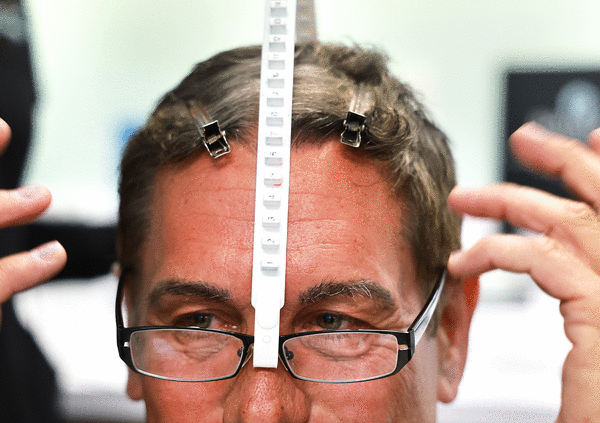
FORT LAUDERDALE, Fla. -- Nick Huffman played Prince Charming in Disney World for 10 years, but about a year ago, he felt a bit uncharming.
His hair loss began to bother him, and Huffman, now an Orlando real estate agent, decided he would head to Turkey, an increasingly popular destination for hair transplants.
Last year, Turkey’s estimated 5,000 clinics drew more than 1 million medical tourists, with hair transplant prices almost a fourth of those charged in the U.S. However, despite the deluge of social media posts from hair transplant recipients, including Huffman, the International Society of Hair Restoration Surgery warns that many Turkish hair clinics are unlicensed and lack proper medical oversight.
Huffman, 42, said he spent about nine months researching which clinic to use, and then did a five-day turnaround to Turkey to get a hair transplant. Now, 13 months post-procedure, he reports being happy with the results. “It looks natural to me.”
Not everyone, though, is pleased.
In South Florida, hair surgeons say they are correcting hair transplants performed by Turkish operators, while also working to draw clients with an arsenal of new options to prevent hair loss, restore thinning hair, and transplant follicles in novel ways.
South Florida doctors are making corrections
Those who can afford it shell out up to $20,000 to get hair transplants in the U.S., which have become much more natural-looking over time. Surgeons, like Dr. Alan Bauman in Boca Raton, can now extract individual healthy follicles from the more abundant areas of patients’ heads and implant them, one by one. In Turkey, transplants are often performed not by doctors, but by technicians, who charge about $3,000 and use a variety of methods to move hair follicles from one part of the head to another.
“You get these influencers, who say, ‘Oh, look at me, I went to Turkey, and I got this amazing result,’ and some of them do, but you know, not everyone does,” said Dr. Brett Bolton, a Fort Lauderdale hair transplant surgeon. “When you go to someone who is not as skilled, you run into a lot of issues.”
Bolton said unsatisfied transplant recipients are coming to him with unnatural hairlines. “It’s as if someone took a marker and drew a line across their forehead. They look bizarre, and they want it fixed.”
Bolton said he uses a modified follicle transfer technique to make the hairline look more natural. “It allows me to achieve more density for the patient and get them out of my office with less surgeries.”
Bauman, a hair restoration surgeon, also treats patients for transplant corrections.
“What’s happening is that you have a commodification and an erosion of the pricing from unregulated clinics, and that’s the attraction — it’s cheap,” Bauman said. “People are coming back from Turkey and their donor areas are completely destroyed, depleted, and overharvested, and their hairlines are much too low.”
Hair loss goes mainstream
Yet even as Bauman and South Florida hair specialists repair damage done in Turkey, the country’s transplant allure has helped push hair treatments into the mainstream. From TV commercials to TikTok reels, marketing campaigns for new drugs, shampoos and topical treatments encourage the quest for a full head of hair.
The American Hair Loss Association says two-thirds of American men will experience hair thinning by their mid-30s, and 85% will experience significant hair loss by 50. And, it’s not just men. About one-third of women experience hair loss at some time in their lives and among postmenopausal women, as many as two-thirds suffer hair thinning, according to Harvard Health. In addition, hair loss is a side effect of GLP-1 drugs, sold under brand names like Ozempic and Wegovy.
“There are a lot of younger men and women who are experiencing hair loss. But also, on the flip side, today there are more treatments available on the earlier side of hair loss,” Bauman said. “You don’t have to wait until you’re totally bare, bald, or whatever to undergo treatments.”
Hair-loss medications like Finasteride have proved effective in restoring hair on the top and back of the head, although the drug does have side effects. Minoxidil, when used topically, thickens hair and slows loss. Other options, such as red light therapy caps, are non-invasive devices that use low-level light therapy to stimulate hair follicles and increase density. Doctors like Bauman sell a medical-grade red light therapy cap to be worn for about 5 minutes daily, with the expectation of improved hair density within 90 days.
A retail display in Bauman’s office showcases some of the treatments now available: oral supplements, powders, topical serums and shampoos.
Hair clinics go high-tech
Bauman’s Boca Raton 29-year-old clinic is now filled with the latest technology — machines that simulate hair restoration to better visualize transplants, another device that will map and color-code the health and density of each hair follicle, lasers that stimulate hair growth without the need for surgery, and instruments that can grab hair follicles to transplant without shaving the head.
Along with treatments, focus has shifted to preservation and regeneration. Hair banking is underway at South Florida hair clinics, where doctors remove young, healthy hair follicles for cryo-preservation before they are affected by hormones or age. They can then be used later if technology matures to allow cloning or stem cell therapies to multiply the follicles. Stem cells also hold promise. Acorn Biolabs, a Toronto-based company, is breaking new ground by collecting a person’s hair follicles and harnessing the power of stem cells to develop topically applied serums unique to each individual.
Bauman said his practice is participating in a clinical trial with Acorn, applying stem cells topically with microneedling. “It’s more of an observational study. So far, we have gotten great results.”
A newer category to emerge is regenerative treatments. Unlike traditional hair loss drugs (which block hormones) or transplants (which move hair), regenerative treatments use cellular signaling to tell your body to start growing hair again. In Bauman’s office, the doctor performs two such treatments: Platelet Rich Plasma (PRP) and exosomes, which he applies topically on the scalp to stimulate dormant follicles.
In many cases, transplants are paired with Exosome Therapy and PRP — biological “boosters” that signal dormant hairs to wake up and start growing alongside the new grafts.
One treatment remains elusive. As of 2026, hair cloning is not commercially available anywhere in the world. But it is considered the future of hair restoration and a potential solution for people with advanced hair loss. It involves taking a few healthy hair follicles, replicating them in a laboratory to create thousands more, and injecting them back into the scalp to grow new, permanent hair. Most experts believe it is at least five years away from becoming available.
A satisfied customer
Ted Fisher, a 59-year-old from Boca Raton, received PRP in Bauman’s office at the same time as a hair transplant.
“I came here because my hair is very important to me, and I just saw it was receding,” Fisher said during a follow-up visit. “My forehead was getting a little larger than I wanted, and it was getting a little light in the back. It was just the perfect scenario for a transplant,” he said.
Bauman used a modern technique to move healthy hair from the back and sides of Fisher’s head to the areas with hair loss in the front, using a newer instrument called follicular unit extraction. He plucked individual hair follicles one by one from sections with healthy hair on the back of Fisher’s head and moved to them to the thinning areas.
Fisher said he is satisfied with the outcome. He considered going to Turkey for the procedure, but decided against it. “It’s more money here, but you pay for what you get,” he said.
“I just felt more comfortable dealing locally and with someone who has an amazing track record,” he said. “Once you start Googling then you’ll see the Turkey stuff is always popping up. For some people, I’m sure it’s okay, but I’m sure there are some horror stories, too, and I don’t want to be one of the horror stories.”
Back in Orlando, Huffman knows he took a risk as a medical tourist. His transplant in Turkey was done by technicians, rather than a Turkish doctor, who he said would have charged him more than twice as much. He said a doctor participated in his on-site consultation.
More than a year later, Huffman said he is 98% satisfied, only disappointed with one section that’s a bit thinner than the rest. “I’m probably the only person who notices it,” he said.
Through TikTok and Instagram posts, Huffman documented his hair transplant journey like many other Americans. “I paid $3,000 to overcome a decade of insecurities,” he said. “The feedback has been positive. Everyone is behind me and I have a lot of people reaching out asking about my experience.”
©2026 South Florida Sun Sentinel. Visit at sun-sentinel.com. Distributed by Tribune Content Agency, LLC.


















Comments