The Outfit That Only Exists Standing Up
Published in Fashion Daily News
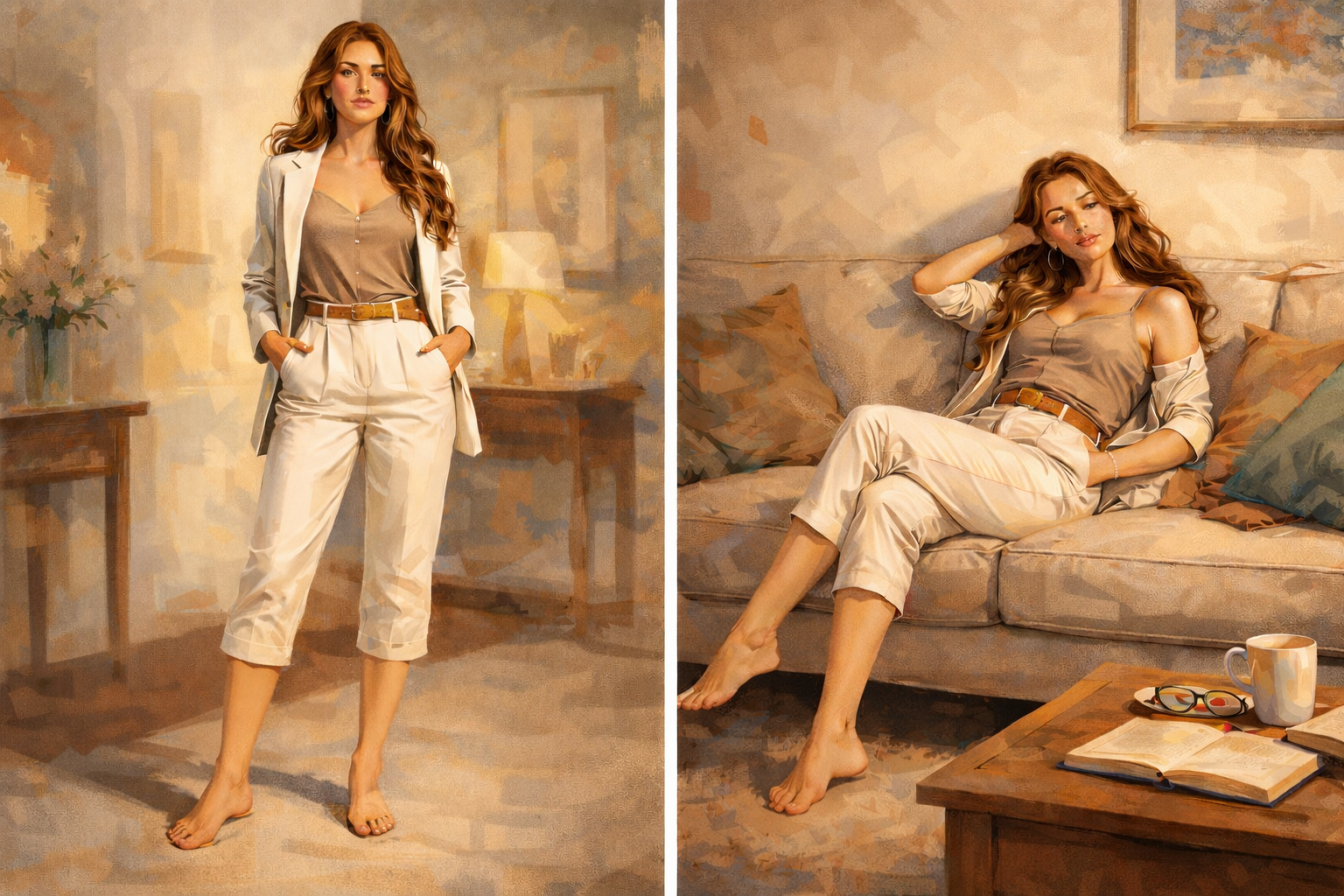
She checks the mirror one last time before leaving. Everything works. The lines are clean. The fabric falls exactly as intended. Nothing pulls, nothing bunches, nothing betrays the illusion. It is, in every sense, a successful outfit—composed, deliberate, complete. Then she sits down.
What was crisp becomes creased. What was smooth gathers. The waist shifts, the hem rides, the structure softens into something less certain. It is not a failure exactly, but it is a different truth. The outfit that existed in the mirror—upright, composed, slightly aspirational—does not survive contact with the chair.
This is the quiet category most closets contain but few acknowledge: the outfit that only exists standing up.
The Mirror Version
Clothing is often designed and evaluated in a vertical world. Showrooms, fitting rooms, and mirrors all assume a body that is upright, balanced, and still. The ideal presentation is a standing one, where posture can be controlled and angles are favorable.
In that context, an outfit can achieve near perfection. A jacket sits cleanly along the shoulders. A waistband aligns with the natural line of the body. A skirt falls just so, uninterrupted by movement or gravity’s interference. The person wearing it becomes part of the composition, holding the shape as much as the garment does.
The mirror reinforces this version of reality. It offers a static, curated view—one that privileges symmetry and stillness. Small adjustments are made: a tug here, a smoothing gesture there. The result is an image that feels complete.
But it is an image built for a moment, not a day.
The Sit Test
The transition from standing to sitting is where the illusion reveals itself. It is rarely dramatic. Instead, it unfolds in small, cumulative shifts.
Fabric that lay flat begins to fold. Seams pull slightly off their intended lines. A skirt inches upward, a shirt gathers at the waist, a jacket that looked structured now presses awkwardly against the torso. None of it is catastrophic, but all of it is noticeable.
The wearer becomes aware of the outfit in a new way—not as something presented, but as something managed.
Adjustments follow. A hem is tugged downward. A waistband is shifted. The posture changes subtly to accommodate the garment rather than the other way around. Sitting becomes a negotiation between comfort and appearance, one that must be recalibrated each time the body moves.
The “sit test,” as some quietly call it, is less about failure than about translation. The outfit has moved from one mode of existence to another, and not all designs make that transition gracefully.
Clothes for Moments vs. Clothes for Living
At the heart of this distinction is a question of purpose. Some clothes are built for moments—arrivals, first impressions, the brief span of time spent standing in a doorway or reflected in a mirror. Others are built for living, for the long stretches of sitting, reaching, leaning, and shifting that make up most of the day.
The tension between these categories is not new, but it has become more visible as daily life has changed. Work that once required formal dress now often unfolds at desks, on couches, or in hybrid spaces where the line between public and private has blurred.
In these environments, the limitations of “standing outfits” become apparent. A garment that performs beautifully in motion or at rest can become restrictive or fussy when worn for hours in a seated position. The wearer may not consciously articulate the problem, but the body registers it nonetheless.
By contrast, clothes designed with movement and duration in mind tend to recede into the background. They do not demand constant adjustment. They allow the wearer to sit, stand, and move without interruption. They are, in a sense, less visible—and therefore more successful.
The Performance of Posture
Wearing an outfit that only works while standing often requires a subtle but persistent performance. The body is held in a particular way—shoulders back, spine straight, movements measured—to maintain the intended silhouette.
This is not always uncomfortable, but it is rarely neutral. It asks something of the wearer: attention, restraint, a willingness to prioritize appearance over ease.
The effect can be most noticeable in social settings. Standing conversations, brief encounters, and transitional moments all support the illusion. But as soon as the context shifts—someone sits, lingers, relaxes—the demands of the outfit become more apparent.
In this way, posture becomes part of the garment. It is not just worn; it is maintained.
The Quiet Rebellion of Comfort
Against this backdrop, choosing clothes that function equally well sitting and standing can feel like a small, private act of resistance. It is a decision to prioritize continuity over presentation, to favor garments that adapt to the body rather than the reverse.
This does not mean abandoning structure or style. Instead, it reflects a different set of priorities—ones that account for the full range of daily life rather than a single, curated moment.
The shift is often subtle. A waistband with a bit more give. A fabric that drapes instead of constricts. A cut that accommodates movement rather than limiting it. These choices may not register in the mirror in the same way, but they assert themselves over time.
The outfit may not achieve the same immediate impact. It may not produce that brief, satisfying moment of perfection before the door. But it endures.
The Second Look
There is a point, often unremarked, when the wearer catches sight of themselves again later in the day. Not in the controlled environment of the mirror, but in a reflection glimpsed in passing—a window, a darkened screen, a moment of stillness.
The question is not whether the outfit still looks as it did at the start. It rarely does. The question is whether it still works.
Clothes that only exist standing up tend to lose coherence as the day unfolds. They require resetting, re-smoothing, reassertion. Clothes designed for living settle in. They change slightly, but they remain aligned with the body they are meant to serve.
In that second look, the difference becomes clear.
The mirror version was never the whole story. It was only the beginning.
========
Lenora Vance is a lifestyle and culture writer focused on the intersection of clothing, behavior, and everyday environments. She writes from a place where the couch is considered a primary testing ground for design. This article was written, in part, utilizing AI tools.






Comments