Where does California stand in the vote-by-mail legal saga now? Here's what to know
Published in Political News
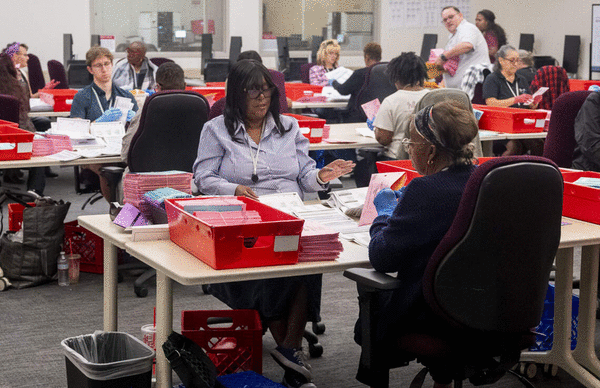
The Supreme Court on Monday struck down an injunction barring the Trump administration from enacting new rules for mail-in voting, raising questions about the process just weeks before California plans to send ballots to 23 million voters for the November election.
But the legal saga continues. Late Thursday, a judge issued a temporary restraining order again blocking implementation of the new rules.
What would the ruling, backed by the court’s six conservative justices, really do? Here are six things to know.
What is this case about?
In March, President Donald Trump issued an executive order, directing his administration to obtain lists of U.S. citizens who were registered to vote in every state. He also directed the U.S. Postal Service to use those lists to track ballots mailed to voters by the states.
The postal service was then ordered to refuse to accept any ballot addressed to someone who was not on the list. All ballots would have to be in envelopes approved by the federal government that included bar codes to identify the voters. The order also directed federal prosecutors to prioritize prosecutions of any election official believed to be violating election laws.
The administration said its plan would make elections more secure, and keep non-citizens from voting. But voting rights advocates said it would inject chaos into an important election cycle and could disenfranchise millions of people.
Lawsuits filed
Two major lawsuits were filed to stop the order. The first, filed on April 2 by the League of Women Voters and other groups, said releasing new rules so close to the election could disrupt the midterm elections, and deprive many eligible citizens of the right to vote. The executive order, it said, amounts to “an extraordinary and abusive assertion of executive power over the administration of federal elections.”
The next day, California and the attorneys general of 24 other states filed their lawsuit. It argued that the order violated the Constitution, which delegates the running of elections to the states. It also argued that the states would incur high costs to retool their election systems and create the new ballots, and characterized the order as an effort by Trump to unilaterally rewrite election laws and obtain confidential voter information from the states.
Both cases were heard by U.S. District Judge Indira Talwani in Massachusetts, who issued similar injunctions in each. Her injunction in the states’ lawsuit was the one overturned by the Supreme Court.
Will I be able to vote by mail in the fall elections?
California, where voters will choose a new governor, Congressional representatives, legislators and other office-holders, is still planning to mail ballots on or before Oct. 5, Secretary of State Shirley Weber’s office said. The ruling by the high court is not by itself likely to affect the election, experts interviewed for this story said.
That is because the ruling was technical, and not based on the constitutionality of the president’s order, said Leslie Gielow Jacobs, a constitutional scholar at the University of the Pacific McGeorge School of Law in Sacramento.
The Supreme Court did not order states to comply with Trump’s order, or uphold its constitutionality, Gielow Jacobs said. Instead, the six conservative justices said in an unsigned opinion that the states had filed their lawsuit too early — before the order had been implemented, or any formal rules pertaining to it had been developed.
“They’re saying, ‘We don’t know how these officials are going to implement the directive, and we are going to presume at this point that they would do it in a way that is in accordance with law,’” Gielow Jacobs said.
The states would have to wait until the policy was formalized to argue that it was unconstitutional or that it harmed their interests, the majority wrote. Until then, they wrote, the case was “unripe,” a legal term meaning that alleged harm upon which a lawsuit could be based had not yet taken place.
But they left open the possibility that rules developed under the order might not survive scrutiny, even writing that their decision “does not mean that any measure taken by the Government to implement the order will necessarily be lawful.”
“On that score, time will tell,” the majority said.
What would the policy actually do?
If the executive order is enacted and ultimately upheld by the courts, states would have to provide lists of eligible voters to the federal government, and any mail-in ballots would only be sent to people on those lists. Local elections officials could be prosecuted if they are deemed to have broken any federal laws.
In his initial March order, Trump said the changes would make elections more secure.
“Unique ballot envelope identifiers, such as bar codes, enable confirmation that only citizens receive and cast ballots, reducing the risk of fraud and protecting the integrity of federal elections,” the order said.
But voting rights advocates and some legal experts say it could create chaos and make it difficult for registered voters to cast their ballots — particularly if elements of the order go into effect before the midterms.
To comply, states would have to retool their processes for printing and mailing ballots, a potentially expensive process that might be difficult to achieve quickly. They would also have to develop and submit lists of registered voters — which could also be hard to do quickly and accurately.
“I think it represents a threat to voters,” said Stephen Kaufman, an election attorney with offices in Los Angeles and Sacramento. “It’s going to lead to disenfranchisement of voters, and it is going to undermine the integrity of elections.”
What happens next?
The issues raised by the case are moving quickly. Even as the justices were preparing to release their opinion, the postal service did in fact develop and release a new rule about mail-in voting.
The rule, which took effect on Aug. 26, said states would be required to put ballots in approved envelopes with bar codes on them, and that states would have to provide the federal government, through the postal service, with the names and addresses of all eligible voters.
In response, both the states and the League of Women Voters went back to court this week, saying that it was no longer too soon to contest the administration’s policy. Led by California, the states filed their action in the form of a new lawsuit, while the League of Women Voters filed a supplemental complaint in its existing case.
Talwani, the judge, quickly set dates for new hearings, and late Thursday night issued a temporary restraining order blocking key parts of the new rule for at least two weeks. The rule, she said in her order, goes into effect after states have already ordered their ballots, and with too little time remaining before the midterm elections. Some states, she pointed out, are required by law to send their ballots out in just a few days.
She ordered the administration to alert the postal service within 24 hours that its employees were barred from implementing the rule. Hearings to codify the order further into a preliminary injunction are set for Sept. 3.
Talwani’s order may eventually be struck down, but some experts say that by then it could be too late to implement the new rule in time for the November elections.
“Are Californians going to be able to vote by mail?” asked Mary-Beth Moylan, an election law expert at the University of the Pacific McGeorge School. “We don’t know yet. Probably yes.”
Will the new rules ultimately be struck down in the courts?
Talwani’s latest order may not be the end of the proceedings. The administration could soon appeal again, and experts say this issue will likely wind up back before the Supreme Court.
Any new injunctions issued by Talwani will likely be appealed, said Moylan. And whichever party doesn’t prevail in the appeal will probably go to the high court.
There, the president’s order and the post office rule enforcing it will certainly be opposed by the Court’s three liberal justices, who disagreed with the conclusion that opponents had filed their case too soon. Justice Ketanji Brown Jackson said the order — and her colleagues’ failure to overturn it — “needlessly injects chaos and uncertainty into the upcoming midterm elections.”
The decision, she said, was part of a “Kafkaesque” series of precedents making it difficult for plaintiffs to bring election-related cases.
But any final result — whether before or after the upcoming fall elections — would hinge on the court’s six conservative justices, who have not yet considered the president’s policy on its merits.
“We’re going to have more opinions on this in the next days and weeks,” said Moylan. “I think people should just stay tuned.”
_____
©2026 The Sacramento Bee. Visit sacbee.com. Distributed by Tribune Content Agency, LLC.












































Comments