How Lisa See's new novel explores the lives of 3 Chinese women in 1871 LA
Published in Books News
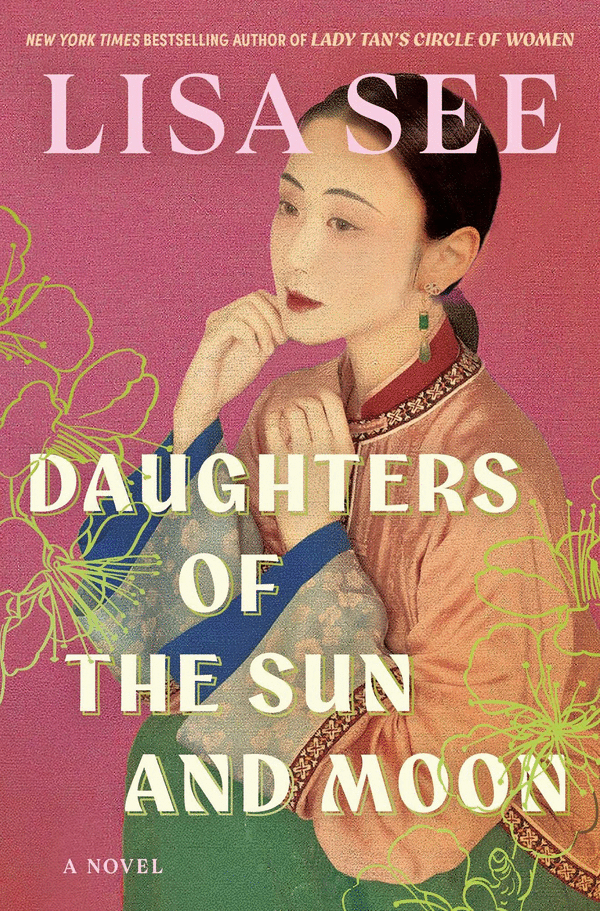
Novelist Lisa See spent years on the El Pueblo de Los Angeles Historical Commission, and she recalls times when she’d start thinking about the history that had occurred just outside the window of Pico House, where the meetings took place.
“I could see from my seat that corner where my great-grandparents had their start here,” she says on a recent Zoom call, referring to her forebears Fong See and Letticie Pruett, who in 1897 moved from Sacramento to Los Angeles to open an antiques shop in Chinatown.
“Of course, that’s also right where the massacre was,” See adds.
The Chinese Massacre of 1871, in which at least 18 Chinese men were killed by a violent mob, is a key part of See’s new book, “Daughters of the Sun and Moon.”
But it’s not the heart of the story, which beats in unison through the stories of three Chinese women whom See based on real people. In 1870, only 34 Chinese women lived in Los Angeles, which had a population of 5,000.
Petal, Dove and Moon are an unlikely trio, representing the different experiences of Chinese women who lived in the city and the state at the time the story takes place.
Petal is a teenager, sold into prostitution in a Los Angeles brothel after she was shipped across the Pacific to San Francisco. Dove is a beautiful and cultured young woman sent to the city for an arranged marriage as the second wife of a much older merchant. Moon is in her mid-20s, the wife of a respected doctor of Chinese medicine.
In addition to the newspaper articles, court records and other historical documents that provided background for the characters and events in “Daughters of the Sun and Moon,” four generations of See’s family history in Los Angeles, much of it in the city’s Chinatowns, fueled her imagination, she says.
“I think it’s always been very hard for me to look at that piece of land, which is now just a grassy knoll between Union Station and the gazebo in the plaza, and not think of what happened there,” she says of the spot where much of the violence of Oct. 24, 1871, occurred. “To not think of my family as well, because that was where they set down their roots.”
In 1870, when the novel begins, the spot was home to the Coronel Block, a building that included the homes and businesses of many of the Chinese residents of downtown Los Angeles killed or injured in the massacre.
It stood on Calle de Los Negros, later part of Los Angeles Street, in an area that was a corner of Chinatown until the buildings there, including the original See store, were demolished in 1949 to make way for the 101 Freeway.
In addition to an antique store at street level, the Sees had a restaurant in the basement, where during the hard times of the Depression, Lisa See’s father and grandparents had also lived.
“When I was a kid, our family’s store was only a few blocks from there,” See says of the shop on Ord Street directly across from Phillipe the Original restaurant, where their family business relocated.
“My grandmother would take me for walks along Spring Street and through Olvera Street,” she says. “We’d get to the plaza, and she’d always point to where the family had had the store for about 50 years on that corner.”
“It’s really a big part of our family history,” she says. “And just a good serious throw down the block is where the Coronel Block was,” See says. “Of course, that part of Calle de Los Negros was eventually taken away and Los Angeles street run through. So we don’t know exactly where Calle de Los Negros was.
“But it’s five feet this way, 10 feet that way. Mainly, it’s gone
“I really have spent a lot of time thinking about those walks with my grandmother, and how she always pointed out that corner,” See says. “But she never talked about what had happened right there.”
In an interview edited for length and clarity, See talked about the real-life inspirations for her characters, why her research for the book included growing Chinese herbs, and how the city of Los Angeles will soon complete a new multi-site memorial to honor and remember the Chinese Massacre of 1871.
Q: Why did your great-grandparents decide to move to Los Angeles, given the tragedy of the still-recent massacre?
A: The story was always that my great-grandparents, a mixed-race couple at a time when it was against the law for them to be married, came to Los Angeles because they viewed it as being safer. They would have viewed it as safer because of what the city fathers did after the massacre.
First of all, get rid of everything that you could see [related to the massacre], but also try to sell Los Angeles as a place that was safe for anyone coming here. That was a land of opportunity, great weather, and good for health. All of those things that are still selling points today. They were looking to be safe themselves, but also to have safety for their mixed-race children.
Q: You’ve lived in Los Angeles almost all of your life. When did you learn of the Chinese Massacre?
A: It was when I was doing research for “On Gold Mountain” [her 1995 memoir and family history]. There was so much history about the Chinese in America, but particularly in California, that I had never known. We didn’t learn it in school. All we learned was that the Chinese helped on the railroad, and that was it.
Q: These characters are based on real people: Yut Ho was the inspiration for Dove, Tong Yu did the same for Moon, and Sing Ye and Sing Yu both became Petal. Tell me how you found these women and what you learned about their lives.
A: Yut Ho [Dove], you know, her kidnapping was big, big news in the local newspapers. [After her marriage to a Los Angeles merchant, the leaders of two Chinese tongs fought over her, with their battles precipitating the massacre.] There wasn’t a Chinese newspaper; it was just the American press, and they had a lot of fun with it.
All of the quotes in the novel are from the actual newspaper accounts. She was “the old man’s pet,” and there was a whole sort of fantasy about whether she really ran off with this guy who was so handsome, but the husband was “hideously ugly.” That seems a pretty rude thing to write in the newspaper. [She laughs]
There was a fair amount written about her. And then, of course, her recovery, none of that is known. The speculation for Yut Ho, who was the inspiration for Dove, she could have been sent home. She could have still lived with her husband. He could have sold her into prostitution. She may have never been recovered and just disappeared. It’s unknown.
With Moon [Tong Yu], very little is known about her because she was just the [doctor’s] wife, right? But there were certain facts that she did exist. Quite a bit about her husband. What he wore, that he spoke four languages. That she was there with him [in the massacre].
That she had filed a lawsuit against Yo Hing [head of one of the tongs, accusing him of being the cause of the kidnapping and riots that led to the massacre]. I was able to find the original document, the original complaint, at the Huntington, but there’s nothing that comes after.
There are a lot of holes in the records that are kept. A lot of stuff thrown out, a lot of stuff destroyed, so who knows? Maybe she pursued it, maybe she didn’t. I just imagined why [Moon] would have dropped it.
Q: And Petal is a composite of two women?
A: There were these two women who kept running away [from brothels], or in the case of one of them, had been kidnapped and tortured, and she still ran away. The main sources are these court documents and also some newspaper articles about them, because these were kind of titillating stories to write about.
I’ve been thinking about just driving around as we do in Southern California. How long would it take to walk these distances, if you’ve run away from downtown Los Angeles? How long would it take to walk to, in her case, just this side of Santa Barbara? How long does it take to walk that barefoot?
What I found so inspiring about these two women is that they did everything they could to escape and find freedom. And, of course, eventually, they again disappear out of the records.
Q: With such limited information, how did you build out the three women as the rich characters they become?
A: Well, one thing right off the bat, without knowing anything else except for those basic facts, you know that they’re from different classes and different statuses within the community. Dr. Tong was the most respected Chinese man in Los Angeles. His patients, most of them were White, so he was very, very well respected. So you have to figure his wife [Moon] is in a different category than a prostitute, even though they’re living in the same building, this one long building.
Then the wife [Dove], there is that tradition of having multiple wives. My own great-grandfather, when he was in his 60s, he brought back to Los Angeles a 16-year-old girl and had another seven children with her. That seemed something I was pretty familiar with, and as the wife of a merchant – my great-grandfather was also a merchant – I understand how she was treated and how she lived.
She had been kept inside completely except for very special occasions. I had a pretty good feel for that and how separate that is from somebody [like Moon] who is meeting White patients, someone who could be a female presence in the doctor’s office.
Another way to identify them or separate them was by their feet. [Dove] is going to be carefully taken care of. She’s bound-footed; she’s like a precious little jewel over here. The working girl [Petal] has to have big old feet. And then I thought it would be interesting to have somebody whose foot-binding had gone wrong and what effect that would have on her. [Moon’s feet were damaged, and she walked with a limp.]
Q: You also write their chapters from different points of view. Petal in first person, Dove in third person, and Moon in first person, but looking back at what happened from half a century later.
A: Dove, I was thinking of her in a sense of how she was like an object. That idea, that she was described as this man’s pet lamb, and all the language used in the newspapers about her was again like she was this little jewel, this little thing that was being passed around.
Then with Petal, who’s in the first person, I just wanted to be in her shoes, following what’s happening with her in the moment. Moon, originally I was going to write the whole story from Moon’s perspective. I do like stories where you’re right in the moment. But I really was worried about how people would think of Los Angeles in that time.
People think of Los Angeles in the past as film noir or things in the ’30s. It’s movies and television, and what we have seen of Los Angeles is not from 1870. Like what you said earlier, this really was the Wild West. There are scholars who say it was one of the most, if not the most, violent of the Wild West towns.
So in Moon’s very first scene, she addresses that. There are no cars, there are no telephones, there are no movies, no paved roads. I felt that was going to really help me first with readers, and trying to get them to see this little dinky town of 5,000 people, but also she has perspective on what happened that the other characters don’t. I like that, as she was telling the story, she would know things that Dove and Petal didn’t.
Q: Beyond the characters, it’s clear you did a lot of research on the physical aspects of Los Angeles in 1870, from how things looked in the streets and buildings to what a doctor of Chinese medicine would stock in his office.
A: It was three years. All the paper stuff that the Huntington had really helped me. They also now have a Chinese medicinal herb garden. I met with the curator of that and one of the docents who’s a traditional Chinese medical practitioner.
I tried growing herbs myself [as Petal does for Dr. Tong] to see, Could somebody who has the worst dirt, the worst light, mid-winter, could she grow something on her little window shelf? Yes, she could. I’m sure she did a better job than I did, but I tried it just to make sure.
And just things I touched on. How long would it take to walk from here to there? How long on horseback? How long in a carriage that’s drawn by two or four horses? I didn’t know. And what buildings were there? There’s some great collections of photographs, obviously not a lot from 1870. There are very few trees in the photographs. You can see very few trees in Los Angeles yet.
It’s all interesting, of course. I love Los Angeles, and I love Southern California history, so it was really fun for me.
Q: You’re part of the 1871 Memorial Project to remember the Chinese Massacre. How much do you think Southern Californians today know of what happened?
A: I don’t think that much, even in the Chinese community, although I think people are learning more about it. For example, I was at a lunch last week with 10 women, and we all had to go around and say what we’re working on right now. When I got to the end of talking about the new book, there was only one person who’d heard about the massacre. So two out of 10, that’s not very broad.
Q: And what’s the current status of the project?
A: It was supposed to be done by the end of this summer. I think it is next summer but I just feel safer saying by the Olympics. The money has been raised for phase one, which is the main site, right there on Los Angeles Street. It has 18 granite-like trees, one for each man who was killed. But there are another, I think it’s nine, what we call for lack of a better word, satellite sites.
So one would be Goller’s Wagon Shop, where people were hung outside. But also locations where there were Good Samaritans who hid people, to tell the other side of the story. There was a farmer out on, I want to say what’s now Seventh and Figueroa, who hid 60 people in his farm’s outbuildings.
I think of people coming out of buildings at, let’s say, Seventh and Figueroa, knowing, “Oh, there was a farmer here who saved people’s lives,” or coming out of another building. “Oh my God, nine people were hung here.”
Q: It’s important history to remember.
A: I think there’s value in knowing that, because, yes, Southern California has come a long way since the 1870s, no question. But there are other things that go on that I think make that history seem pertinent and relevant today.
Q: Like the ICE immigration raids and arrests last year?
A: A lot of what happened was down by the Plaza. A lot of damage done there, unfortunately, but interesting that it was that spot again. But do people know that? It’s, you know, the more things change, the more they remain the same.
Going back to what the city fathers did in 1871, I think they had a belief that we can’t let this happen ever again. And then you have years later the Watts riots, and we can’t let that happen again. And then you go many more years later, and Rodney King, and what happened after those verdicts. And we can never let that happen again.
So I do believe that we always have the best intentions. I like to believe that we have the best intentions. But history does have a way of repeating itself.
©2026 MediaNews Group, Inc. Visit ocregister.com. Distributed by Tribune Content Agency, LLC.







Comments