Sam Bankman-Fried's motion for new trial rejected by US judge
Published in News & Features
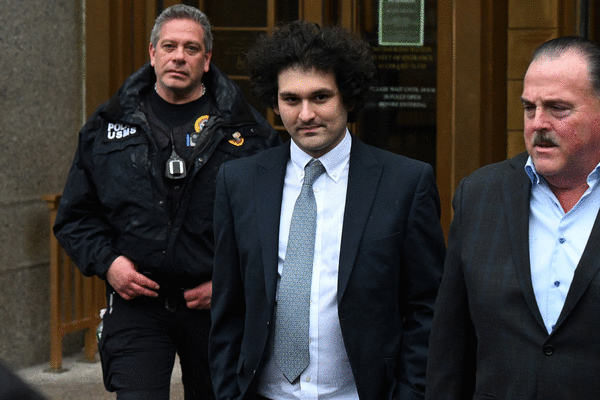
NEW YORK — A federal judge rejected FTX co-founder Sam Bankman-Fried’s do-it-yourself motion for a new trial based on what the former crypto king claimed was new evidence.
U.S. District Judge Lewis Kaplan, who oversaw Bankman-Fried’s 2023 trial and conviction before sentencing him to 25 years in prison, denied the request on Tuesday in New York. The ruling came even after Bankman-Fried had asked to withdraw his request, claiming the judge wouldn’t be fair in deciding it. The judge rejected that, too.
Bankman-Fried’s conviction and sentence are being considered separately by the federal appeals court in New York, where he’s represented by Alexandra Shapiro, a specialist in criminal appeals. But in an unusual move, Bankman-Fried also sought a new trial on his own, filing a motion without going through his legal team.
That strategy has won him little beyond the apparent annoyance of the judge, who resoundingly rebuffed the motion and said it “appears to be one part of a plan to rescue his reputation that Bankman-Fried hatched and even committed to writing after FTX declared bankruptcy but before he was indicted.”
Bankman-Fried is confined in a federal prison in Lompoc, California. He told Kaplan that he wrote the legal filings himself, but shared drafts with his parents, retired Stanford Law professor Barbara Fried and Joe Bankman, a current member of the Stanford Law faculty. He said he incorporated some of their suggestions.
Seven counts
Prosecutors charged Bankman-Fried with seven criminal counts including fraud and conspiracy, claiming that he illegally transferred billions of dollars from FTX customer accounts to an affiliated hedge fund, Alameda Research. Risky investments by Alameda contributed to FTX’s collapse, which was buffeted by a broader crypto downturn in 2022. A Manhattan jury found him guilty of all the charges.
In his motion, Bankman-Fried argued that two former FTX executives who didn’t testify at trial, Daniel Chapsky and Ryan Salame, would counter the prosecution’s story about the exchange’s financial condition. Salame, who separately pleaded guilty, was sentenced to 7 1/2 years in prison.
Star witness
He also claimed that Nishad Singh, FTX’s former head of engineering, changed his story about the collapse following “threats from the government.” Singh was one of the prosecution’s star witnesses at Bankman-Fried’s trial. He pleaded guilty to fraud and was able to avoid prison due to his cooperation with the government.
Bankman-Fried’s claim that the three former FTX executives were prevented from testifying in his favor by government threats and retaliation is “wildly conspiratorial and entirely contradicted by the record.”
Appeal hearing
At Bankman-Fried’s appeal hearing in November, Shapiro argued to a skeptical panel of three appeals judges that Kaplan wrongly blocked the defense from telling jurors there was plenty of money to repay investors, despite the collapse.
Kaplan also blocked Bankman-Fried from telling jurors about advice he got from lawyers, after an unusual hearing in which the judge put Bankman-Fried on the stand for three hours, outside the presence of the jury, to preview his proposed testimony.
The case is U.S. v. Bankman-Fried, 22-cr-00673, U.S. District Court, Southern District of New York (Manhattan).
_____
©2026 Bloomberg L.P. Visit bloomberg.com. Distributed by Tribune Content Agency, LLC.




Comments